Discover Calm Cruising: How Navigation Gear and Communication Tools Make Your Bourgogne Houseboat Trip Safer, Simpler, and More Fun
Why Navigation Gear and Communication Tools Matter on Bourgogne Houseboat Voyages
You might think cruising the gentle canals and rivers of Bourgogne is all about sipping wine, passing sleepy villages, and enjoying slow lock dances. And you’d be right—mostly. But even in these tranquil waters, good Navigation Gear and Communication Tools turn a pleasant trip into a confident one. They give you situational awareness, help avoid awkward groundings, speed up lock transits, and provide immediate lines to help when things don’t go exactly as planned.
One area where your navigation skills meet practical seamanship is the art of tying up and handling the boat—if you want to look relaxed and efficient at the quay, consider brushing up on modern and classic techniques. A detailed reference on Docking, Mooring, and Tie-up Techniques can provide step-by-step guidance that complements the gear you carry, from the right fenders to how and when to use a handheld VHF during a busy tie-up. That knowledge reduces stress and keeps your boat and crew safe when navigating tight berths and locks.
Another practical angle to consider is how your living setup aboard the houseboat influences your choice of Navigation Gear and Communication Tools. Comfort and access matter: a well-thought-out galley, secure storage, and clear instrument placement make it easier to use electronics and reach emergency gear in a hurry. For a broader checklist of what belongs on board, check out On-Board Living and Boating Essentials, which pairs nicely with navigation planning and ensures that life on the water is both comfortable and safe.
Finally, remember that all this navigation and communication tech needs reliable power to do its job—without it, the best GPS or VHF is just a nice paperweight. You’ll want to understand battery capacities, charging cycles, and fail-safes before you set off. A solid primer on Power Systems and Battery Maintenance explains how to keep devices charged, how to monitor battery health, and which backup options you should carry to avoid being stranded with dead comms in a narrow channel.
Think of your navigation and comms kit as a travel companion: not flashy, but quietly dependable. It reduces stress, shortens learning curves if you’re new to boating, and makes you look like someone who knows what they’re doing—without pretending. In short: the right setup helps you enjoy Bourgogne’s scenery with one eye on the view and the other on safe seamanship.
Essential Set for Bourgogne Houseboat Voyages
When packing for a Burgundy houseboat holiday, prioritize reliability and redundancy. You don’t need ocean-going survival gear, but you do need smart tools that work well in narrow channels, near locks, and under bridges. Here’s the practical, no-nonsense kit that will get you through most inland scenarios:
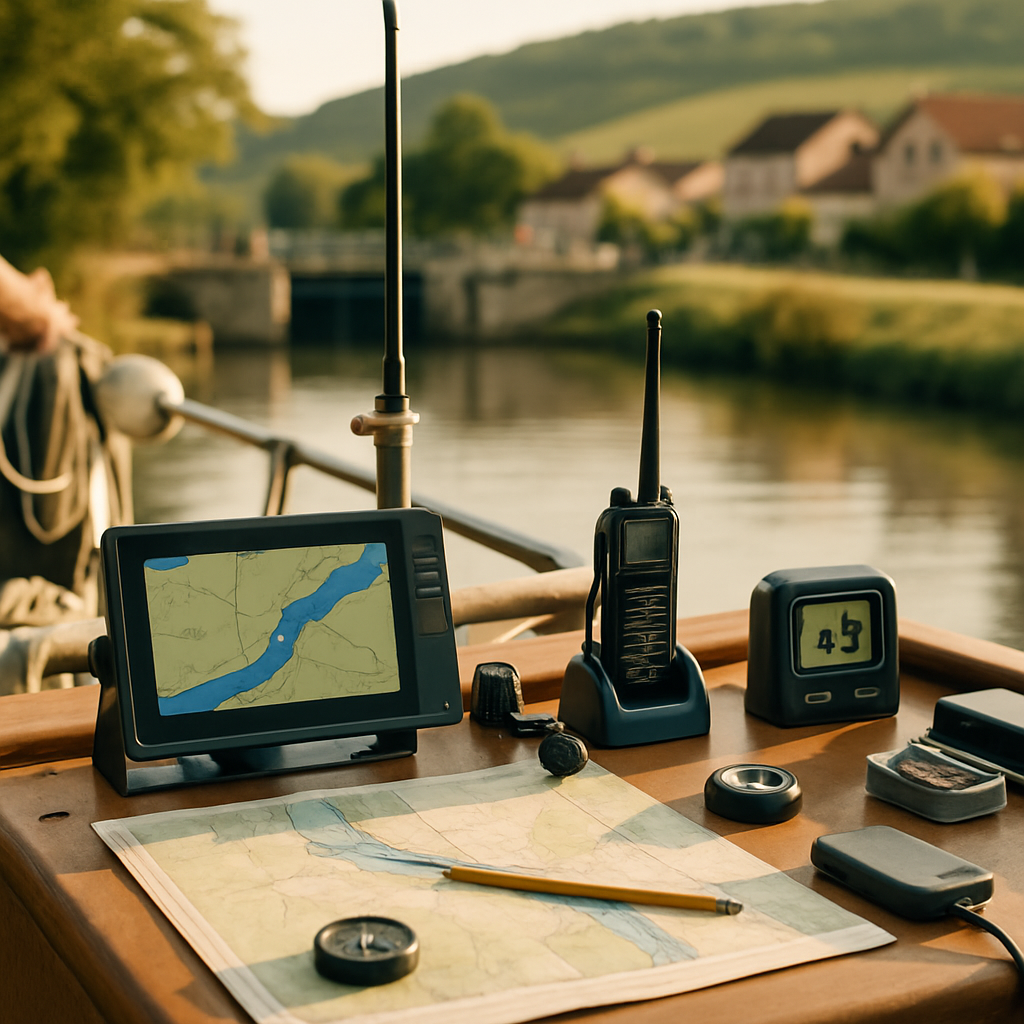
- Paper charts and local cruising guides: Yes, still invaluable. Paper is your ultimate offline backup and often contains lock diagrams and berth tips not in apps.
- Magnetic compass: Small, low-tech, and it never needs a recharge.
- GPS/chartplotter or a tablet with charting app: Either a dedicated plotter or a tablet running Navionics/C-Map is essential for route planning and position fixes.
- Depth sounder (echo sounder): Crucial in shallow channels or parts of rivers where sandbars and sudden shallows appear.
- VHF radio (fixed) with a good antenna: Your main tool to contact locks, marinas and other boats.
- Handheld VHF: A portable backup for tending lines or moving ashore.
- AIS receiver (or Class B transponder): Helpful in busier stretches to see commercial traffic approaching.
- Mobile phone with local SIM + power bank: For bookings, maps, and local coordination—always keep offline maps available.
- Portable satellite messenger (optional): Ideal as a fail-safe if you venture beyond cell coverage.
- Spare batteries, chargers, basic tools: Don’t underestimate lost hours due to a dead handheld or a bad cable.
Choosing Navigation Gear and Communication Tools for Tranquil Bourgogne Waters
Choosing gear for inland waterways like Bourgogne is an exercise in balance: you want capability without unnecessary cost or complexity. Ask yourself what you really need for your usual itinerary and then add one layer of redundancy.
Here are the practical factors to weigh when choosing equipment:
- Range needs: VHF and AIS are more than adequate for inland links—satellite is usually overkill unless you plan remote tributaries.
- Shallow-water accuracy: Choose depth sounders with adjustable sensitivity and a reliable transducer placement on the hull.
- Ease of use: Go simple. Big buttons, clear text, and straightforward menus will save you time and frustration, especially if crew change during the week.
- Power use: Houseboats have decent battery capacity, but keep an eye on drain. Low-power devices and smart charging behavior stretch your resources further.
- Integration: NMEA connectivity is great if you want devices to share GPS, depth and AIS info. If that sounds like a headache, a well-equipped tablet as a secondary solution works fine.
- Durability: Splash-proof, dust-resistant devices last longer in the damp, canal-side environment.
- Future upgrades: Buy modular where possible—add an AIS module or external GPS antenna later if you find you need it.
VHF Radios, AIS, and Other Safety Communication Tools for Bourgogne Marine Adventures
Short-range voice and digital comms are the backbone of inland boating. Here’s how each tool fits into your safety net.
VHF Radio — Fixed and Handheld
VHF is the workhorse. A fixed VHF with a high-mounted antenna gives you the best range for contacting locks, bridge operators, and marinas. Handhelds are handy for moving about the deck or when you go ashore to deal with lines. Two quick tips: make sure your fixed VHF has DSC (Digital Selective Calling) and register for an MMSI number if you use DSC—DSC can send a distress alert with position to rescue authorities. Second, always store handhelds in a dedicated, charged cradle so they’re ready when you need them.
AIS — Receiver or Class B Transponder
AIS shows vessel names, positions, speed and heading. On busier canals and river sections, AIS keeps you informed of large barges or commercial traffic that might not be obvious until late. An AIS receiver gives you situational awareness; a Class B transponder broadcasts your position to others and is a smart upgrade if you’re often near commercial channels.
Other Useful Communication Tools
- Mobile phones + local SIM: Great for non-urgent logistics, bookings, and map backups. Always download offline charts—roaming can be pricey.
- Satellite messengers: Small two-way devices (like Garmin inReach-style messengers) offer SOS and text communication beyond cellular range.
- Weather radio & apps: Inland weather can be cheeky—apps provide forecasts, but having a small weather radio or an app that pushes updates ensures you won’t be surprised.
Satellite Communications on Houseboats: Pros, Cons, and Practical Tips for Bourgogne Travelers
Satellite comms are alluring—global reach, SOS, and the ability to message from the middle of nowhere. But on Bourgogne trips, they’re generally a luxury or an emergency backup rather than a necessity.
Pros
- Coverage beyond mobile networks: Useful if you cruise remote tributaries or want guaranteed SOS capability.
- Reliable emergency channel: Two-way messaging and SOS through a reputable satellite network can be lifesaving.
- Live tracking: Some devices share your track with family—handy for peace of mind.
Cons
- Cost: Hardware plus subscription fees add up quickly.
- Data limits: Satellite services often have limited data and are not suitable for streaming or heavy browsing.
- Line-of-sight restriction: Narrow canals lined with trees or buildings can reduce performance, so placement matters.
Practical tip: for Bourgogne, a small satellite messenger with SOS and two-way text is usually the best compromise. It’s inexpensive compared to full satellite broadband and gives you emergency connectivity without extra baggage.
Integrating Navigation Apps with Traditional Gear for Your Bourgogne Adventure
Smart integration gives you flexibility. Modern apps are brilliant for planning, weather, and backups, but they’re best used alongside dedicated instruments rather than instead of them. Here’s how to make apps and traditional gear play nicely together.
Key Integration Strategies
- Use offline charts: Don’t rely on a signal. Download Navionics, C-Map or similar charts for Bourgogne before you leave—and keep copies on your tablet and phone.
- Sync waypoints and routes: Export GPX files from your tablet to the plotter (or the other way around) so everyone is following the same plan.
- Connect sensors: If possible, use an NMEA gateway or Bluetooth GPS to feed your tablet with accurate antenna GPS, depth and AIS data for a reliable secondary display.
- Match datums and units: Ensure both devices use WGS84 and the same units—mismatched settings are a classic source of positional error.
- Secure mounting and power: Waterproof mounts and dedicated charging minimize the chance of losing your best backup at a critical moment.
Remember: apps are flexible and great for planning or sharing your trip, but keep one authoritative source—either your chartplotter or paper charts—for final navigation decisions.
Maintenance, Testing, and Best Practices for Navigation Gear and Communication Tools on a Houseboat
Gear that’s not tested is just hope in a plastic box. Regular maintenance and simple pre-departure routines protect you from day-one failures and reduce stress mid-cruise. Here’s a pragmatic guide to staying shipshape.
Routine Checks and Pre-Departure List
- Power on fixed VHF, handhelds, plotter and tablet—verify each boots and holds charge.
- Inspect antenna mounts and cables for corrosion or loose fittings.
- Test handheld VHF transmit/receive at short range (be courteous—don’t clog emergency channels).
- Confirm GPS position on plotter and tablet match the true position; check for satellite lock timeouts.
- Check depth readings at familiar spots to ensure your echo sounder is giving sensible numbers.
- Verify AIS reception/transponder transmission if fitted.
- Top up spare batteries and make sure charging cables are accessible.
- Download weather and tide data (if applicable) and brief the crew on emergency procedures.
Periodic Maintenance (Monthly to Yearly)
- Clean connectors and apply dielectric grease to prevent corrosion.
- Update firmware and charts during off-season so you’re not updating in a marina under a drizzle.
- Inspect and service antennas and transducers—replace anything that shows wear.
- Load-test batteries and confirm charging system integrity.
- Conduct a full communications drill with the crew so everyone knows how to call for help and use equipment.
Best Practices While Underway
- Keep a proper lookout—electronics are aids, not replacements for eyes and experience.
- Use VHF proactively—announce intentions when approaching locks or narrow bends.
- Log anomalies—note odd device behavior, time and conditions for later troubleshooting.
- Respect radio etiquette—avoid non-essential traffic on emergency channels.
- Train all crew on where spares are and how to operate basic comms tools.
Pre-departure Checklist (Printable)
- Power on fixed VHF and handheld—check audio and mic function
- Verify MMSI registration and DSC settings (if equipped)
- Confirm chartplotter and tablet have latest charts and consistent position
- Inspect antennas & connections—secure and corrosion-free
- Check depth transducer and echo sounder readings in known shallow points
- Confirm AIS receiver/transponder operation
- Charge spare batteries and power bank
- Download offline charts and weather forecast
- Brief crew on VHF use, emergency routine, and device locations
FAQ — Common Questions About Navigation Gear and Communication Tools
Do I really need a VHF radio for Bourgogne canals?
Yes — you should have a VHF. It’s the quickest and most reliable way to contact lock keepers, marinas, or other boats. A handheld VHF will do as a minimum, but a fixed VHF with a high-mounted antenna gives better range. Make sure your handheld is charged and stored in a known place so you can grab it when things get busy.
Is AIS necessary on a houseboat in Bourgogne?
AIS isn’t mandatory for most recreational inland cruising, but it’s very helpful. An AIS receiver gives you situational awareness of larger vessels, which is handy in busier commercial stretches. If you regularly navigate near commercial traffic, consider a Class B transponder so other vessels can see you too.
How do I get an MMSI number and why does it matter?
You need an MMSI to use DSC on a VHF radio. In many countries you can apply online through the national maritime authority or a radio licensing body. Registering links your vessel identity with your radio so a DSC distress alert sends your position to relevant rescue services—an important safety step you shouldn’t skip.
Can my smartphone or tablet replace a chartplotter?
Your phone or tablet is an excellent backup and planning tool, but don’t make it the only piece of navigation kit. Screens can fail, batteries die, and apps crash. Use offline charts and keep either a dedicated chartplotter or paper charts as your authoritative source for navigation decisions.
Which satellite option should I choose for emergency use?
A two-way satellite messenger (like an inReach-style device) is usually the best fit for Bourgogne trips: it’s compact, relatively affordable, and provides SOS and text messaging where cellular fails. Full satellite broadband is expensive and typically unnecessary for inland cruising.
What are the best practices for powering navigation and comms gear?
Manage power proactively: monitor battery states, use low-power settings where possible, and keep spare power banks and charged handheld batteries onboard. Learn the basics of your houseboat’s charging system and perform periodic load tests so you’re not surprised by a dying battery mid-trip.
How often should I test and maintain the gear?
Do quick pre-departure checks every day you leave the berth: power on radios, confirm GPS positions, and check depth readings. Perform more thorough maintenance monthly or seasonally—clean connectors, update firmware and charts, and test antennas and transducers for consistent performance.
Are there legal requirements for radios and AIS in France?
Regulations vary by vessel type and size. For most small recreational houseboats on inland waterways in France, a handheld VHF is sufficient, but if you carry DSC you must register an MMSI. AIS requirements are generally aimed at commercial traffic, but check local rules or your rental company’s guidance before you go.
How do I communicate with lock keepers and marinas?
Use VHF to announce your approach and intentions—simple calls are best. If a lock or marina uses a specific channel, stick to it and follow local protocols. When in doubt, call on the general working channel and identify yourself and your position; the staff will tell you what to do next.
What should I include in an emergency communication plan?
Make a short plan: which device you’ll use (VHF first, then phone, then satellite), who to call (local emergency numbers and the marina), and where spare equipment is stored. Teach everyone on board how to make a DSC call and send a satellite SOS. Practice the plan once so it’s not a dry run when stress hits.
How much should I budget for basic navigation and comms gear?
For sensible, reliable kit expect to spend on a handheld VHF and mounting cradle, a basic chartplotter or tablet with charts, and a depth sounder—budgeting modestly can land you with a functional setup in the low-to-mid hundreds to low thousands of euros, depending on brand and whether you buy new or used. AIS receivers and satellite messengers add extra cost but are optional based on your needs.
Can I integrate apps with onboard sensors easily?
Yes — many modern devices support Bluetooth or NMEA gateways to share GPS, depth and AIS data with tablets and phones. It’s worth setting this up so your tablets show the same reliable data as your chartplotter. Just make sure the datum and units match across devices to avoid confusion.
Final Thoughts
Navigation Gear and Communication Tools give you confidence, not just capability. On Bourgogne waterways, a pragmatic combination of VHF, basic AIS, a reliable chartplotter or tablet with offline charts, depth sounder, paper charts and simple redundancies will cover most scenarios. Keep things simple, test often, and train your crew so everyone knows what to do if the unexpected happens.
At the end of the day, the best setup is the one you understand and maintain. With the right gear and a little preparation, you’ll spend less time worrying about what might go wrong and more time soaking up the scenery, sharing a good meal, and drifting into those slow, lovely French evenings that make houseboating in Bourgogne unforgettable.