Catch the Calm: How to Master Docking, Mooring, and Tie-up Techniques on Bourgogne Waterways
Introduction
Calm canals and gentle rivers of Bourgogne can lull you into thinking docking and mooring are effortless. They can be — if you know the basics of Docking, Mooring, and Tie-up Techniques and bring a little preparation, common sense and a friendly crew. This article walks Du through practical, step-by-step methods for approaching quays, tying up to banks, choosing safe spots and avoiding the small mistakes that spoil a relaxing trip. Expect useful knots, an equipment checklist and situational tips tailored to houseboats and the particular charm (and quirks) of the Burgundy waterways.
Before you cast off or try your first approach, make sure your onboard systems and supplies are organised so you can focus on seamanship rather than scrambling for gear. A quick review of navigation electronics and comms is always worth ten extra minutes — check recommended setups in Navigation Gear and Communication Tools. Likewise, double-check living arrangements and safety basics with the guidance in On-Board Living and Boating Essentials, and plan provisioning and smart storage using tips from Provisioning and Storage for Weeklong Trips so you arrive relaxed and ready to tie up.
Docking, Mooring, and Tie-up Techniques: A Bourgogne Marine Starter Guide
Whether it’s your first houseboat holiday or you’re brushing up after a winter ashore, a clear, calm routine is everything. Docking, Mooring, and Tie-up Techniques are less about bravado and more about planning, crew coordination and small, deliberate moves. Below you’ll find the essentials, practical actions you can use the first time you see a mooring ring or a quiet bank.
Core principles to remember
- Plan before you act: look up- and downstream, note wind direction and identify entry/exit routes.
- Slow is smooth: controlled, tiny throttle inputs beat large corrections every time.
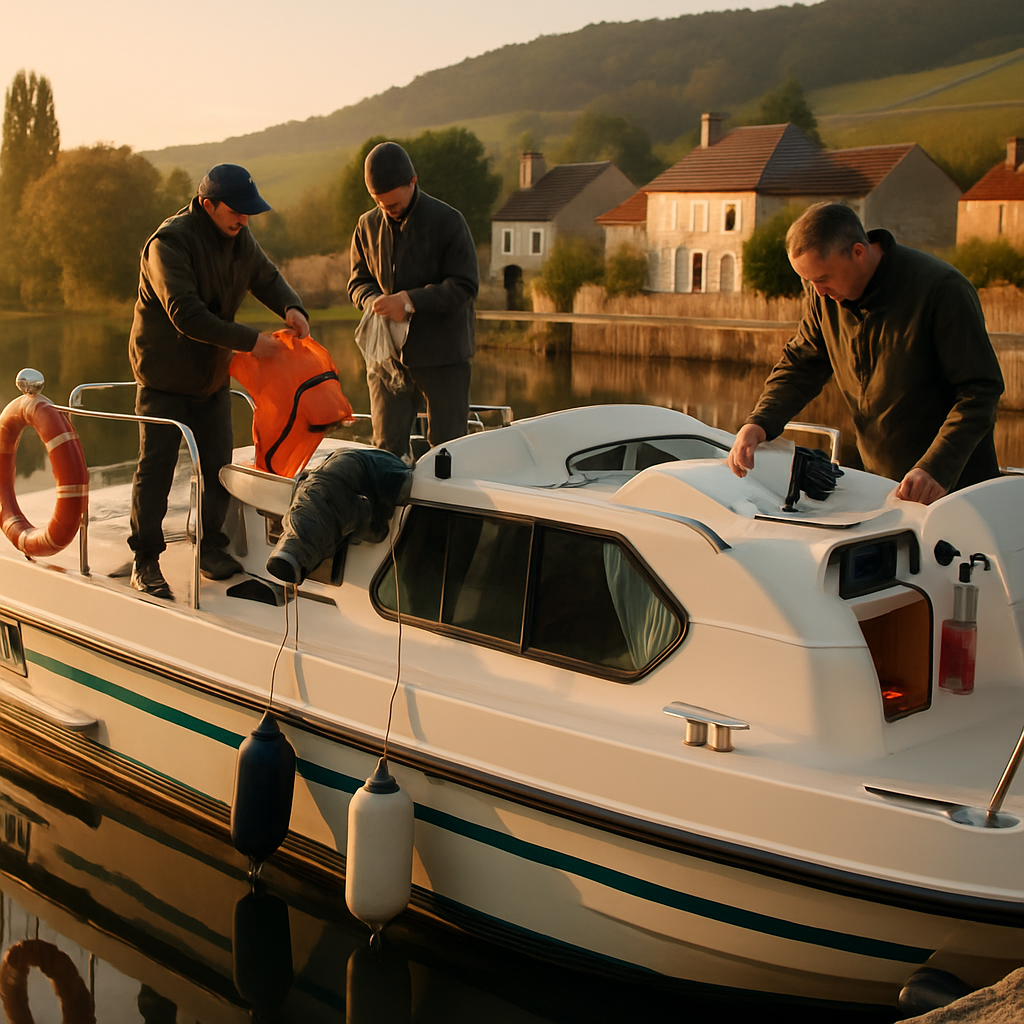
- Prepare gear early: fenders, lines and a boat hook should be ready long before you touch the quay.
- Assign clear roles: designate who handles lines, who steers and who watches traffic — brief everyone aloud.
- Respect the environment: avoid stressing banks, roots, or fragile moorings and follow local mooring signage.
Choosing Safe Mooring Spots in Bourgogne’s Calm Waterways
A picture-postcard mooring beside a shaded willow is lovely — until a gust comes through or another boat passes and sends unexpected wash. Choosing safe mooring spots is a balance of convenience, safety and respect for local rules. Here’s how to pick good spots and what to avoid.
Quick checklist to evaluate a mooring site
- Depth and bottom type: check for enough depth at low water; firm bottoms (sand, clay) hold anchors better than loose silt.
- Shelter from wind: moor on the lee side of a bank, island or quay to reduce strain on lines.
- Traffic and current: avoid narrow stretches where larger vessels create wakes or where currents change near locks and bridges.
- Infrastructure and rules: prefer maintained quays and official mooring rings. Look for signs that restrict overnight stays or private moorings.
- Access and security: consider how you’ll get ashore for provisions and whether the spot is lit and reasonably safe at night.
- Environmental considerations: respect reed beds and wildlife, especially during nesting seasons; avoid tying to protected vegetation.
Gentle Approaches to Docking: Tie-up Techniques for Houseboats on Bourgogne Rivers
Houseboats are heavy, broad and respond slowly. You’ll rarely need dramatic maneuvers; instead, practice gentle approaches that give you margin for small errors. These steps are ideal for the narrow bends and slow currents you’ll find between Chalon-sur-Saône and Auxerre.
Step-by-step approach to docking
- Brief your crew: name roles, decide signals and lay out lines and fenders while still a good distance away.
- Set fenders early: position fenders where the hull is likely to make contact — bow, midship and stern as needed.
- Approach at a shallow angle (15°–30°): a shallow approach converts forward motion into lateral control and reduces the need to reverse aggressively.
- Use short bursts of power: small throttle inputs maintain steerage; neutral lets you drift — balance both as needed.
- Work wind and current to your advantage: approach slightly upwind/upcurrent to let the wind/current slow you as you close in.
- Secure a spring line quickly: this line controls fore-and-aft motion and lets you drop other lines without fighting drift.
- Finish with breast and bow/stern lines: these hold the boat snugly to the quay and distribute load across multiple points.
If you feel nervous, pick a quieter spot and practice. There’s no shame in circling and trying again — patience is part of seamanship.
Practical tips while tying up
- Step slowly from bow or stern when stepping ashore; keep one hand on a secure grip and the other free for the line.
- Use a boat hook to catch rings and to fend off if the hull drifts too close.
- Keep a knife accessible (sheathed) in case a line jams and must be cut; know where it is before you need it.
Securing Your Vessel: Practical Mooring Techniques for Bourgogne Canals
Canal moorings are often slower-water affairs, but that doesn’t mean “set and forget.” Water levels can vary slightly, other boats will pass and natural debris can accumulate. Here’s how to secure a houseboat safely for hours, overnight or longer stays.
Canal mooring basics
- Use multiple attachment points: tie to bow, stern and an amidships point if possible to spread load and reduce strain on any one cleat.
- Spring lines are essential: even on calm canals, spring lines keep the boat from sliding forward/back when another vessel passes.
- Allow for water level changes: leave a little extra slack or use elastic mooring lines for small rises and falls.
- Protect from chafe: fit sleeves or padding where lines rub on gunwales, cleats, or rings.
- Check moorings periodically: a short walk to inspect lines and fenders at dusk and dawn saves headaches and repairs.
Common Docking Pitfalls and How Bourgogne Marine Recommends Avoiding Them
Even seasoned skippers fall into the same traps: impatience, poor communication and underestimating the effects of wind. Here’s a list of common mistakes and straightforward ways to avoid them.
Top mistakes and fixes
- Rushing the final approach: fix it by slowing down earlier, rehearse the approach mentally and position lines minutes before arrival.
- Deploying fenders too late: put fenders out while you can still maneuver with full visibility and control.
- Unclear commands: agree on short, simple phrases — “hold,” “forward,” “slack,” “take in” — and stick to them.
- Single-point reliance: never depend on just one mooring point; use redundancy.
- Over-tight lines: allow elasticity to absorb movement — set a comfortable, not rigid, tension.
Equipment and Prep: What to Bring for Docking and Mooring in Bourgogne
A well-packed docking kit makes everything easier. Pack thoughtfully and put the kit where anyone on board can grab it quickly. Here’s what Bourgogne Marine recommends.
Essential gear
- Multiple fenders (various sizes) and spare fender lines.
- Mooring lines of different lengths (6–20 m) with adequate strength; include elastic mooring lines where recommended.
- Boat hook, boat pole and gloves for safe handling of lines.
- Chafe guards, spare shackles, snap hooks and a small set of basic tools.
- Anchor with sufficient scope and a dedicated warp of adequate diameter.
- Headlamp or flashlight and reflective tape for early departures or night checks.
- Throw rope or life ring and a safety knife accessible to crew handling lines.
Useful Knots and When to Use Them
Knowing a few reliable knots will save time and stress. Here are the go-to knots for Docking, Mooring, and Tie-up Techniques, what they do and why you’ll use them.
| Knot | Use | Why it works |
|---|---|---|
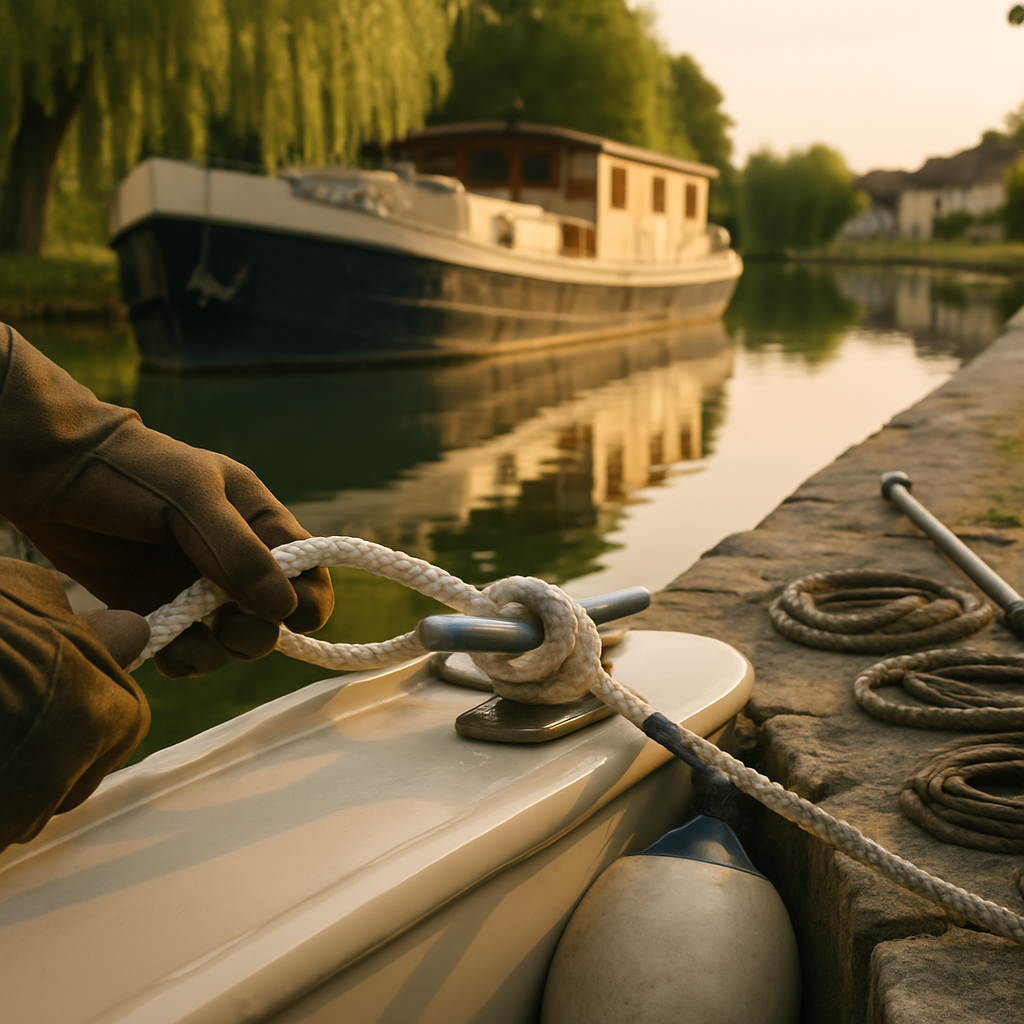
| Cleat hitch | Securing a line to a cleat | Secure under load, quick to release when needed |
| Round turn + two half hitches | Tying to a post or ring | Adjustable and strong, good for variable loads |
| Bowline | Create a fixed loop | Doesn’t jam, easy to untie |
| Figure-of-eight on a bight | Strong loop for anchors or snubbers | Simple, secure and easy to inspect |
Practical Tips for Night and Overnight Mooring
Nights on the canal are quietly beautiful — but they require extra care. A few practical routines will keep Du sleeping well and the boat safe.
- Inspect before dark: make a final walk around to check chafe points and fender placement.
- Leave slack but not too much: allow slight movement for level changes while preventing excessive drift.
- Mark mooring points: reflective tape on lines or cleats helps when leaving before dawn.
- Mind wildlife: be aware that animals and floating debris can tangle lines; check periodically.
- Respect local rules: many villages limit overnight mooring in prime spots — ask locals or check signage.
Emergency and Backup Procedures
Even with careful technique, things happen. Having a simple, rehearsed backup plan turns potential panic into manageable work. Read this and run a dry rehearsal with your crew when you’re not under pressure.
Simple emergency steps
- If a mooring line parts: have a secondary line already prepped. If not, use the engine in short bursts to steer while crew readies another line.
- If you drift off the quay: don’t panic—short, gentle bursts and a boat hook to fend off will often save the day while lines are recovered.
- If someone goes overboard: throw a life ring immediately, keep eye contact, and maneuver slowly — make rescues practiced before you need them.
- If a mooring fixture looks unsafe: don’t load it. Use an alternative point and report the faulty gear to local authorities.
Final Checklist Before You Leave the Helm
- Fenders placed and secured where hull meets quay.
- Lines prepared, untangled and ready to pass.
- Spring, breast, bow and stern lines in place and not over-tight.
- Chafe protection in critical spots.
- Crew briefed on departure signals and their roles.
- Check local signs and respect mooring rules or private property.
FAQ
Which questions do people search most often about Docking, Mooring, and Tie-up Techniques?
Q: How do I properly tie up a houseboat so it won’t drift or strain the cleats?
A: Start by preparing your fenders and having lines ready before you get close to the quay. Approach slowly, secure a spring line first to control fore-and-aft movement, then add breast lines and bow/stern lines to distribute load. Leave enough elasticity in the lines to allow small movement without overloading cleats — think supportive, not rigid. Re-check line tension after a few minutes and again at dusk; small adjustments often prevent larger problems.
Q: What knots should I learn for safe mooring and quick departures?
A: Learn the cleat hitch for most quay cleats, the round turn and two half hitches for posts or rings, and the bowline for a reliable loop. The figure-of-eight on a bight is handy for anchors or snubbers. These knots are strong, easy to inspect and, importantly, easy to release under load — which you’ll appreciate when you need to cast off quickly.
Q: Can I moor overnight anywhere on Bourgogne canals?
A: Regulations vary. Many public moorings permit overnight stays but some picturesque village quays are limited or private. Always check signage, ask locals or consult the canal authority if in doubt. Even where overnight mooring is allowed, be respectful: keep noise low, avoid tying to fragile vegetation and follow any posted time limits.
Q: Is it okay to use an anchor instead of docking lines on a canal?
A: Anchoring is a useful emergency option but not ideal for routine canal mooring. Canals can have narrow navigation channels and hidden debris; an anchor can snag or block traffic. Use an anchor when there’s no safe mooring available, ensure good scope, and be mindful of local rules. If you must anchor, keep it short-term and ready to move.
Q: How close should the boat be to the quay for safe boarding?
A: Close enough for safe boarding without stretching — typically one fender’s thickness between hull and quay. You want reliable footing and the ability to step ashore safely with one hand holding a stanchion or rail. Avoid forcing the boat flush against a quay if it causes excessive line tension or hull stress.
Q: What equipment should I always have in my docking kit?
A: Essentials include several fenders of different sizes, mooring lines in a few lengths, a boat hook, gloves, chafe protection, spare shackles and a reliable anchor with warp. Add a headlamp, knife and a throw rope or life ring. Keep these items organised and within reach — when a maneuver becomes busy, the last thing you want is to hunt for a fender.
Q: How do I handle crosswinds or current when docking?
A: Anticipate and counter them by approaching slightly upwind or upcurrent, using a shallow approach angle and keeping small, controlled bursts of power to maintain steerage. Put a spring line on early to control fore/aft movement. If wind is strong, consider postponing a tricky docking and pick a more sheltered spot; sometimes the safest move is the least dramatic one.
Q: What should I do if a mooring line parts at night?
A: Stay calm and act quickly. If you have a secondary line pre-rigged, use it. If not, use short engine bursts to regain steerage while crew readies another line and deploys fenders. Keep everyone wearing life jackets if conditions are rough. After stabilising, inspect the failed line and fittings, replace or back it up, and note the cause so you can prevent a repeat.
Q: How can I prevent chafing and wear on my lines?
A: Use chafe sleeves or padding where lines contact sharp edges, through rings or over gunwales. Rotate lines if a particular spot shows wear, distribute load across multiple attachments and check wear points daily during longer stays. Replace lines showing significant abrasion — cheap to replace, costly if one fails at the wrong time.
Q: Are public mooring rings always safe to use, and what if they look corroded?
A: Don’t assume — inspect fittings before loading them. If a ring looks corroded or loose, don’t put full load on it. Use an alternate point or add a secondary line to share the load. If it’s a public mooring and unsafe, report it to local authorities: someone else may rely on that ring later. Safety first; reputation follows.
Conclusion
Mastery of Docking, Mooring, and Tie-up Techniques is a mix of preparation, humility and practice. In Bourgogne, where the water is often as calm as a glass of local Pinot, good technique keeps Du relaxed and lets you enjoy the slow rhythm of canal life. Take time to practice in low-traffic areas, keep your gear organized, and treat each mooring as a small project—because it is. With these tips, knots and checklists you’ll tie up with confidence, enjoy safer nights aboard and have more time for the good things: scenic walks, a glass of wine and the soft clack of ropes in the evening breeze.