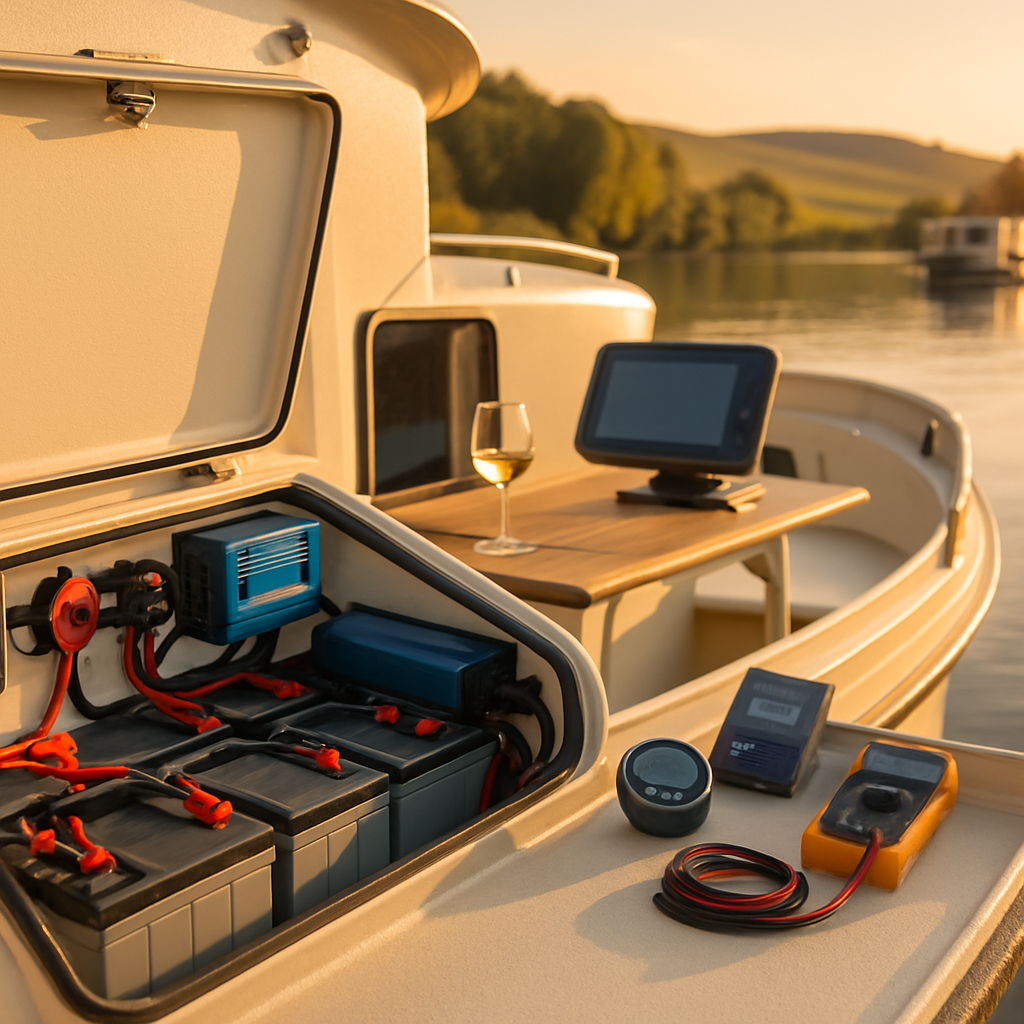
Imagine cruising slowly along a sun-dappled stretch of the Burgundy canals, a glass of local wine cooling in the fridge, lights softly on, and your navigation systems humming without a care. Now imagine that same scene interrupted by a dead battery, a tripped inverter, or a fridge that won’t restart because charging was mismanaged. Not the memory you wanted, right? This guest post dives deep into Power Systems and Battery Maintenance for Bourgogne houseboats—practical, no-nonsense guidance so you can stay powered, relaxed, and ready for another glorious sunset on the water.
Before we dive in, consider a few essential onboard topics.
One practical tip is to integrate your power planning with other onboard systems—for example, your navigation and safety suite, living comforts and water systems. Check guides like Navigation Gear and Communication Tools for suitable VHF and chartplotter needs that draw power, review general On-Board Living and Boating Essentials to balance comfort loads against battery capacity, and consult Water Management and Waste Solutions so pumps and treatment systems aren’t overlooked in your energy budget. These resources help you size batteries and charging sources correctly while keeping comfort and safety in balance.
Power Systems and Battery Maintenance Essentials for Bourgogne Houseboats
When you’re planning a houseboat trip in Bourgogne, reliable power isn’t a luxury—it’s a necessity. From keeping the bilge pump active during a rainy night to ensuring the espresso machine fires up every morning, your power system underpins comfort and safety. That’s why “Power Systems and Battery Maintenance” should be one of the first things you think about before casting off.
Why a clear electrical layout matters
Start by mapping your electrical system as if you were telling a friend how to get to the nearest boulangerie: simple, clear directions, no guessing. Know which batteries serve the house loads, which battery starts the engine, and how shore power, alternator, and solar feed into the system. This clarity helps avoid accidental cross-feeding, over-discharging, or a nasty surprise when the music stops.
Key components you’ll see on every well-run houseboat
- House battery bank sized for daily loads and desired autonomy.
- Starter battery isolated from service batteries to ensure reliable engine starts.
- Pure-sine inverter for AC appliances; consider inverter/charger combos if you use shore power often.
- Smart multi-stage charger with temperature compensation.
- MPPT solar charge controller if you plan to use solar panels.
- Battery Management System (BMS) for lithium banks or appropriate charge protection for lead-acid types.
- Proper fusing, battery switches and an isolation strategy (automatic relays or DC-DC chargers).
Weekly and monthly maintenance routines that actually make a difference
Small tasks, done reliably, prevent big headaches. Once a week: a visual check of terminals, mounts and wiring. Once a month: measure resting voltages after a full charge, tidy up any corrosion, and confirm your charger settings. Log anything unusual—batteries deteriorate slowly, and a log helps you spot trends before they become disasters.
Choosing Battery Types for Houseboats: Lithium, AGM, and Wet Cells on Bourgogne Waters
Picking the right battery chemistry is one of the biggest decisions you’ll make. It affects cost, weight, charging strategy, maintenance needs and how long you can enjoy life away from the marina. Let’s break down the three most common choices so you can pick what fits your cruising style.
| Type | Pros | Cons |
|---|---|---|
| LiFePO4 (Lithium) | High usable capacity, light, long cycle life, fast charging, low maintenance | Higher upfront cost, needs proper BMS and compatible chargers, temperature sensitivity |
| AGM | Sealed (no watering), robust, lower cost than lithium, good for shorter trips | Lower usable DoD (often ~50%), shorter cycle life, heavier |
| Flooded/Wet Cells | Lowest upfront cost per Ah, well-understood technology, can be equalized to restore capacity | Require venting and watering, heavier, needs regular maintenance |
How to choose for Bourgogne trips
Think about your typical itinerary. Weekend escapes? You might be fine with AGM. Extended river cruising with anchoring away from marinas? Lithium’s deeper usable capacity and faster recharge make sense. If you have a classic boat and don’t mind routine care, flooded cells can be cost-effective—but make sure your battery locker is ventilated, especially during equalization charge cycles.
Sizing tips (simple math you’ll actually use)
List your loads: fridge, lights, pumps, instrumentation, charging devices. Convert watt-hours to amp-hours (Wh ÷ 12V ≈ Ah). Add 20–30% margin for inefficiencies and unexpected consumption. For lead-acid, size for 2–3 days autonomy at your usable DoD; for lithium, you can reduce Ah because usable DoD is higher. If this sounds like a spreadsheet nightmare, start with a realistic estimate and oversize slightly—batteries are cheaper than uncomfortable nights.
Battery Health Monitoring: Tools and Best Practices for Bourgogne Marine Journeys
Voltage alone is a poor prophet of battery health. A fully charged battery that’s dying under load will still show decent voltage briefly. If you want predictability, you need better tools and habits.
Essential tools
- Battery monitor (coulomb counter) like the Victron BMV series. This tells you amp-hours in/out and state of charge with real-world accuracy.
- Multimeter for spot checks and troubleshooting.
- Hydrometer for flooded cells to check specific gravity by cell.
- Infrared thermometer or thermal camera to spot hot connections and failing components.
- BMS logs for lithium banks—treat them like a flight recorder for your battery.
Monitoring best practices that save time and money
Install a proper battery monitor and calibrate it after a full charge. Keep a simple log—date, resting voltage, amp-hours used that day, charging current received. Over months you’ll see patterns: reduced time-to-go, greater voltage sag under load, or decreased charge acceptance. These are the early warning signs of aging batteries.
Set alarm thresholds on your monitor for low SOC and abnormal currents. Trust the monitor more than a quick glance at voltage. And when in doubt, measure—don’t guess.
Solar Power, Inverters, and Charging Strategies for Extended Bourgogne River Trips
Solar is a quiet hero for houseboat power systems. In the rolling Bourgogne countryside you can harvest useful energy without a noisy generator, keeping life comfortable and environmentally friendly. But panels alone aren’t enough—MPPT controllers, smart inverter choices, and a clear charging hierarchy matter.
Sizing solar the practical way
Calculate daily energy needs (sum of watt-hours for each device). Divide by average peak sun hours—Bourgogne summers often give 4–5 peak hours; spring and autumn less. Add 20–30% for system losses. For example, 1,500 Wh/day ÷ 4 peak hours ≈ 375 W; add losses → aim for ~480–500 W of panels.
MPPT controllers and the charging hierarchy
MPPT controllers squeeze more out of your panels than PWM alternatives, especially on variable light days or cooler weather common along inland waterways. Build a charging hierarchy: shore power charger (when available) → alternator/DC-DC charger while underway → solar MPPT when anchored. Use priority logic on inverter/charger combos to ensure the highest-capacity source handles bulk charging.
Choosing and using an inverter
Pick a pure sine inverter sized to handle surge loads (starting motors, microwaves) and continuous loads you plan to run. Beware heavy AC loads—hair dryers and kettles eat battery capacity fast. If you use shore power frequently, consider an inverter/charger combo that automatically syncs charging when shore becomes available. Also remember inverter idle draw; switch it off when not needed to save energy.
Safety, Troubleshooting, and Redundancy: Power System Tips Aboard a Bourgogne Houseboat
Safety first—there’s no room for electrical shortcuts on a floating home. Proper fusing, correct cable sizing, ventilated battery lockers and a BMS on lithium systems are essential. Let’s walk through practical measures and troubleshooting steps so you can fix problems calmly, not frantically.
Safety checklist you’ll be glad you followed
- Every positive conductor from a battery should have a fuse close to the battery. No exceptions.
- Use marine-grade cabling and terminals sized for continuous current with headroom for peaks.
- Ventilate flooded batteries to prevent hydrogen buildup; avoid enclosing them without airflow.
- Install emergency battery isolators and clearly label switches—when the captain panics, decisions should be simple.
- Keep an A-B-C electrical fire extinguisher handy and know how to use it. Prevention beats cure.
- For lithium banks, ensure the BMS monitors temperature and voltage at cell level and can disconnect on fault.
Troubleshooting flow that makes sense
When something goes wrong, follow this calm path:
- Observe: What’s failing? Lights? Fridge? Engine start?
- Measure: Check battery resting voltage, then voltage under load. Use a multimeter and your battery monitor.
- Isolate: Remove suspicious loads, isolate battery banks if you have multiple.
- Inspect: Look for loose connections, heat discoloration, corrosion, bulging cases or venting issues.
- Test: Swap in a known-good battery (if available), or try shore power charging to see acceptance current.
Redundancy strategies to avoid getting stranded
- Keep starter and house batteries separate, or maintain an automatic isolating relay that charges both but isolates them for starting.
- Consider dual house banks with automatic transfer so one can carry you home if the other fails.
- Carry a small portable jump pack or 12V boost starter for emergencies.
- Maintain a lightweight DC essentials panel powered by a small backup battery so navigation and bilge pumps stay live even if the main inverter trips.
Seasonal Maintenance Scheduling for Power Systems on Bourgogne Voyages
Seasons in Bourgogne bring changing temperatures, sun hours and usage patterns. A simple calendar of tasks keeps your power system healthy and reduces surprises when you head out.
Spring — pre-season prep
- Perform a full visual inspection: batteries, cables, shore power inlet, charger, inverter and solar panels.
- Charge batteries fully and perform a capacity check. Replace weak batteries before the season.
- Test alternator output and DC-DC charger function; check belt condition and charging voltage while engine runs.
- Clean solar panels and verify MPPT settings; correct panel orientation if adjustable.
Summer — active season care
- Weekly terminal checks and a quick log of voltages and amp-hours used.
- Monitor SOC, especially during cloudy spells or heavy usage periods.
- Watch for overheating during long charging sessions and ensure vents are clear.
Autumn — end-of-season tasks
- Perform a full charge and equalization for flooded cells if recommended by the manufacturer.
- Set chargers for float/storage mode and disconnect unnecessary loads.
- Inspect shore power inlet seals and shore cords for wear—winter water ingress is a sneaky problem.
Winter — storage strategy
- Lead-acid/AGM: keep on float charging or give a monthly recharge to avoid sulfation.
- Lithium: store at 30–60% state of charge and maintain a monitoring charge; prevent exposure to deep freeze—many LiFePO4 cells won’t accept charge below 0°C.
- Disconnect banks if the boat is laid up and maintain a minimal supervised charging regime.
- Monthly: Tighten terminals, check for corrosion, log voltages and charging currents.
- Quarterly: Load-test the battery bank, clean panels, verify charger and inverter firmware/settings.
- Annually: Service alternator and DC-DC charger; equalize flooded banks; replace batteries showing reduced capacity.
Practical charging voltages — a starting point
Always follow the battery maker’s specs first. As a general guideline for 12V systems at around 25°C:
- LiFePO4: bulk/absorption 14.2–14.6V; float typically not required (if used, ~13.4–13.8V). BMS needed.
- AGM: bulk/absorption 14.4–14.6V; float 13.4–13.8V.
- Flooded: bulk/absorption 14.4–14.8V; float 13.2–13.6V. Use temperature compensation.
Temperature compensation matters in Bourgogne—warm summer days and chilly nights can skew charge acceptance. Smart chargers with temp sensors are a big help.
Frequently Asked Questions (FAQ)
Below are questions frequently asked online and by our Bourgogne readers. These focus on practical issues you’ll actually face and what to do about them. Read through and bookmark anything that looks useful for your next trip.
What battery type is best for long Bourgogne river cruises?
For longer cruises where you anchor away from shore power, lithium (LiFePO4) is usually the best option. You get a much higher usable depth-of-discharge, faster recharge from alternator and solar, and a longer cycle life. Yes, the upfront cost is higher, but you’ll appreciate the reduced weight and the fact you can regularly use most of the battery’s capacity without fear of rapid degradation. If you prefer a lower initial outlay and don’t mind limiting discharge, AGM can work for shorter stays or weekend trips.
How do I calculate how many amp-hours I need?
Make a simple list of everything that uses power: fridge, lights, pumps, instruments, chargers, etc. Note each device’s watt or amp draw and how many hours you’ll run it per day. Convert watt-hours to amp-hours at 12V (Wh ÷ 12 = Ah). Add 20–30% for losses. For lead-acid systems, plan around a 50% usable DoD, so double the daily Ah to get battery bank size. With lithium, you can use 80–90% of the pack, so you’ll need fewer Ah for the same autonomy.
Can I mix battery types or old and new batteries?
Avoid mixing chemistries in the same bank. Never parallel a lithium battery with an AGM or flooded cell in the same bank—they have different charge and discharge behaviors, which can stress one or both types. If you must use different batteries on the boat, keep them in separate banks with an isolator, DC-DC charger or smart relay so each bank receives a proper charging profile.
Do I need a Battery Management System (BMS) for lithium batteries?
Yes—absolutely. A BMS protects cells from over-voltage, under-voltage and over-temperature, and it balances cells to maintain pack health. Without a reliable BMS, you risk premature failure or, worse, an unsafe condition. Make sure the BMS is integrated with your charger and alternator charging strategy so it can safely manage charging currents and cut-off when required.
What’s the best way to use solar and alternator together?
Think hierarchy: shore power and a multi-stage charger provide controlled bulk and absorption charge when available. While underway, use alternator charging via a DC-DC charger (especially with lithium) to ensure the alternator isn’t damaged and the batteries get the right voltages. Solar via MPPT is great when anchored and adds incremental energy daily. Use MPPT controllers to maximize output and set priorities so the largest, most efficient source handles the heavy lifting.
How should I store batteries over winter?
For lead-acid/AGM, keep them topped and on float charge or give a monthly recharge to avoid sulfation. For lithium, store at about 30–60% state of charge and maintain monitoring; avoid storing fully charged or fully depleted for long stretches. Also keep lithium cells above freezing if possible—many LiFePO4 packs will not accept a charge below 0°C and can be damaged if charged at too-low temperatures.
What are common signs a battery is failing?
Watch for increased voltage sag under load, reduced time-to-go, a battery that won’t accept a full charge, or excessive heating during charge or discharge. For flooded cells, unequal specific gravity between cells is a red flag. Early detection via a battery monitor and logs will save you from being surprised out on the water.
How can I safely test a suspect battery on the boat?
Start with a resting open-circuit voltage (after the battery has been idle for at least a few hours). Then check voltage under a known load and measure current draw. Use a hydrometer for flooded cells and a battery monitor coulomb counter for amp-hour performance. If you can, perform a capacity test by fully charging, then discharging at a known rate to measure amp-hours delivered. If the delivered Ah is significantly below rated capacity, it’s time to replace the battery.
Is shore power safe for all chargers and inverters in Bourgogne marinas?
Most marinas have reliable shore power, but always inspect the inlet, cord and connections. Use a multi-stage marine charger that can handle varied shore supply quality and has temperature compensation. If you frequently visit basic marinas, consider an isolating transformer or residual-current device (RCD) protection for safety and peace of mind.
What quick steps should I take if my batteries die while cruising?
First, stay calm. Isolate non-essential loads and switch to a backup essentials circuit if you have one (navigation lights, bilge pump, VHF). If the starter battery is dead, try a portable jump starter. If house batteries are flat, seek shore power at the next mooring or run the engine with a DC-DC charger to rebuild charge slowly. Avoid trying to run heavy AC loads from a weak battery—doing so can cause further damage.
Final notes and next steps
Power Systems and Battery Maintenance are not glamorous, but they’re what keep the good times rolling on the canals and rivers of Bourgogne. A little planning, the right equipment and a routine of checks will spare you headaches and help you enjoy more sunsets and fewer electrical mysteries.
If you’re planning a Bourgogne houseboat trip and want a tailored checklist, send your typical daily load list and cruising plan—there are practical tweaks that make a huge difference. With the right approach to Power Systems and Battery Maintenance, you’ll spend your time enjoying the scenery, not wrestling with wires.